Seipsum — Structured Cognitive Systems
Seipsum is a framework for clarifying and structuring thinking in contexts of general and informational complexity, applied through live interaction.
Thinking becomes more coherent when it is reorganised, not simplified.
Cognitive difficulty does not arise from lack of information, but from lack of structure in thinking.
Seipsum builds general cognition as a foundation for metacognition and more.
🔊 Every page can be listened to — press “Listen” on any section, or “Listen to whole page”.
What Is Structured Thinking?
- Structured thinking is thinking that operates on a differentiated field: relevant and irrelevant variables separated, levels of a situation distinguished, contradictory values clarified — before the field compresses into conclusions or action.
- It is not a fixed framework, and not a method of thinking more. It is the organisation of the field thinking operates in. The same cognition, applied to a differentiated field, can produce clarity; applied to an undifferentiated one, it produces effort.
- What is usually called complexity is undifferentiated informational chaos. Through differentiation and compression, the same structure becomes coherent and simple.
- The structure is intangible — variables, levels, values. What structure changes is tangible: decisions, time, actions that hold.
What structured thinking means for cognition is developed in the sections below — starting with the next one: Human Cognition and AI. And besides reading or listening to the content, take time to enjoy the structure as well.
Human Cognition & AI
Complexity isn’t the problem. The problem is unstructured complexity—and it’s costing you time, clarity, and stability.
Most AI systems amplify input and output without improving thinking structure. As a result, similar problems can produce different outputs depending on phrasing, context, or the user's level of clarity.
AI can amplify thinking, but it cannot replace its structure.
When a problem is formulated in an unclear, fragmented, or contradictory way, AI systems tend to amplify those characteristics rather than correct them.
For this reason, access to more information does not always produce greater clarity.
Better thinking does not require more AI or more information, but the improvement of the baseline level of human cognition.
Seipsum introduces an intermediate layer between human cognition and AI systems: a structured cognitive framework that organises complexity before it is processed.
The goal is not to replace AI, but to use it on a more stable cognitive foundation.
The quality of AI-generated outcomes is often limited by the quality of the cognitive structure behind the input.
AI answers questions. Cognitive structure influences the questions being asked.
Seipsum does not provide answers, but delivers structured clarity of presented situations.
Read more about: AI Era and Human Cognition.
Read more about: Founder Experience with AI.
Ready to restructure your thinking? Contact us to start.
Save Time | Gain Value | Structure Cognition
Seipsum Origin
Seipsum emerged from the systemic observation that difficulties in complex contexts do not come from lack of intellectual capacity, but from lack of coherent cognitive structure.
Seipsum is developed independently through interdisciplinary integration of cognition, systems, and thinking behavior.
It did not emerge from abstract theory, but from repeated observation: Intelligent people encountering difficulties not due to lack of knowledge, but due to lack of cognitive structure.
Seipsum is built through:
- Direct observation of real thinking processes
- Progressive organisation of observations into coherent structures
- Conceptual and practical testing of these structures
The focus is not on accumulating more ideas, but on organising them.
Read more about: Founder & Origin.
Read more about: Seipsum Validation.
What Seipsum Is
Seipsum is a cognitive structuring system that enables compression of complexity by reorganising thinking in real time, improving decision-making and interpretation of complex situations.
In practice this means:
- Transforming a confusing situation into a clear structure of action.
- It does not add new information. It reorganises existing information to enable stable decisions.
Seipsum is adaptive, not fixed.
It is used when further analysis produces the opposite effect: cognitive instability and information overload.
Seipsum is designed for:
- Structure
- Clarity
- Noise reduction in cognition
- Decision stability
- Perceptual optimisation
- Improving cognition for general analysis
- Improving the decision-making process
Seipsum is a system of applied methods used in real time on concrete situatuations.
Seipsum transforms complexity into usable clarity through structure, even when complete understanding has not yet been achieved.
Ready to restructure your thinking? Contact us to start.
Save Time | Gain Value | Structure Cognition
Seipsum Intent
The goal of Seipsum is not to simplify reality, but to clarify thinking processes in relation to real and perceived complexity.
This means:
- Separating signal from noise
- Differentiating levels of the problem
- Clarifying contradictory values
- Clarifying variables, dynamics, interactions
- Stabilising decisions under uncertainty
Seipsum exists to introduce structure into cognition.
Who is Seipsum for
For people who:
- Want greater clarity before making decisions
- Work under conditions of uncertainty
- Experience overthinking
- Think analytically and better structure
- Are creators, founders, strategists, or engineers
- Feel they “think a lot, but without clarity"
- Want to develop the foundation on which metacognition is built
Who is Seipsum not for
It is not for:
- People looking for quick answers without structured thinking
- Passive information consumption
- Entertainment or casual conversation
- People unwilling to actively engage with their own thinking
- People who don't want to develop the foundation on which metacognition is built
Ready to restructure your thinking? Contact us to start.
Save Time | Gain Value | Structure Cognition
What Seipsum is not & what to expect (FAQ)
Seipsum is not a predefined program, fixed methodology, or automated system. It does not operate with rigid scripts or identical session structures. Each interaction is adapted to your specific cognitive situation.
❓ Quick Answers
1. Is Seipsum a form of therapy or coaching?
No. Seipsum is a structural cognitive framework—not advice, opinions, or belief reshaping.
2. Do I need prior knowledge to use Seipsum?
No. You only need to bring a real situation or decision to restructure.
3. Will Seipsum give me answers?
No. Seipsum reorganizes your thinking so you can find your own clarity.
4. Is Seipsum a course or training program?
No. Seipsum is a real-time cognitive structuring system, not a pre-recorded or static training. It operates through live interaction, not pre-defined lessons.
5. Does Seipsum work with groups?
No. Seipsum is designed for individual cognitive structuring. Each session is tailored to a specific cognitive situation, not a collective.
6. Is Seipsum based on psychology or neuroscience?
No. Seipsum is a structural cognitive framework focused on the mechanics of thinking, not psychological theories, neuroscience, or belief systems.
7. Will Seipsum tell me what to do?
No. Seipsum provides a structured representation of your situation—not instructions, directives, or solutions. The clarity comes from reorganization, not prescription.
8. Can I use Seipsum for long-term cognitive development?
Yes. While each session delivers immediate structural clarity, repeated use can lead to long-term cognitive improvement through accumulated structuring.
Read more about: Seipsum is Not an Ideology.
How Seipsum Operates
Seipsum operates through and with the "mechanical" processes of thinking and the situations brought by users.
It does not provide advice, opinions, or attempt to reshape beliefs. Instead, it works by restructuring the mechanics and dynamics of cognitive processes—the structure of ideas, not their isolated content.
A Typical Session
A Quick Clarification session is:
- Interactive and structured in real time
- Focuses on organizing elements of a specific situation
- Identifies relevant variables
- Reduces cognitive noise
- Produces a clear structural representation of the problem
Deliverables are typically provided in written structured format, sometimes supported by simplified diagrams.
No extensive preparation is required. Bringing a real situation, decision, or cognitive difficulty is sufficient.
Seipsum is operated through a framework-based process applied by practitioners experienced in cognitive structuring, systems thinking, and complex decision environments.
The goal is not to replace your judgment or provide final answers, but to reorganize the underlying cognitive structure so that clearer decisions become possible.
Read more about: Session Practical Details.
Read more about: Seipsum in Practice.
Practical Details
- Confidentiality is respected in all interactions.
- Seipsum is not a medical, legal, or financial advisory service.
- Follow-up support may be provided depending on engagement type.
- Sessions use standard remote communication tools.
- Can be applied to a wide range of cognitive and decision-related situations (excluding regulated professional contexts).
Pricing, scheduling, and engagement details are provided separately.
The purpose of Seipsum is simple: to transform complex and unclear situations into structured cognitive representations that can be reasoned about more clearly.
How Seipsum works in practice
The user brings a real situation.
Seipsum structures the local and general context, objectively, in real time:
- Separates relevant variables
- Removes cognitive noise
- Identifies relationships between elements
The result is not an opinion, but a clear, objective and simple to understand structure of the situation.
Ready to restructure your thinking? Contact us to start.
Save Time | Gain Value | Structure Cognition
Conceptual Structure of Cognition
Thinking is not a simple process.
It operates on multiple interdependent levels:
- Surface events
- Structural patterns
- Deep causal factors
- Overthinking (cognitive overload)
- Feedback loops and cognitive self-regulation
Without cognitive structure, these levels overlap and generate confusion, decision instability, and perceptual fragmentation.
General cognition is the foundational system—the integrated framework that encompasses all cognitive processes: biases, critical thinking, reasoning, perception, and specialized cognitive functions. These are not separate tools, but interconnected components of a unified whole.
Metacognition is built directly upon this foundation. Without a well-developed general cognition, metacognition cannot emerge. It requires a stable, coherent structure to observe, analyze, and restructure thought itself.
Cognition — Core Principles
Cognition itself is the primary structure through which humans process reality, information, and complexity before any external system or technology.
- Cognition works in layers.
- Perception shapes thinking.
- Unstructured complexity becomes cognitive noise.
- Complexity is often undifferentiated informational chaos.
- Structure transforms complexity into clarity.
- Systems shape thinking more than individual will.
- Cognitive structure determines clarity level.
- Clarity emerges through reorganisation, not through adding more information.
- Complexity compression is the basis of cognitive efficiency.
Metacognition cannot grow without a stable well-developed general cognition.
Overthinking is not inherently a dysfunction; it becomes an advanced cognitive tool within structured cognition.
Metacognition, in its functional sense, is not self-reflection in the vague sense of the word. It is the structural observation of cognition in action: the capacity to watch one's own thinking as a process, identify its patterns, and intervene in its organisation. The founder's development followed precisely this trajectory—from participating in thinking to observing and reorganising it.
General Cognitive Problem
In contexts of general and informational complexity, cognitive difficulty does not come from lack of intelligence or information, but from how information is structured and processed.
The problem is:
- Relevant and irrelevant elements overlap
- Decisions become unstable or delayed
- Clarity decreases
The problem is not thinking itself, but lack of structure in thinking.
The problem is:
- Lack of complexity compression
- Lack of granular separation of concepts
- Lack of organisation of cognitive levels
More precisely:
- Everything appears equally important
- Irrelevant information dominates
- Decision becomes unstable
Overthinking occurs when perceived or real complexity exceeds the structuring capacity of cognition.
Technology and information do not define the limits of thinking; the baseline level of human cognition does.
Metacognition is not a separate skill, nor an advanced add-on to cognition. General cognition—the ability to process, differentiate, and stabilize information—must first reach a level where the mind can observe its own patterns without collapsing into noise. Without this foundation, metacognition is unattainable, as one cannot restructure what is not yet coherent. At Seipsum, metacognition is the structural observation of cognition in action, but only after general cognition has been developed enough to sustain it.
Ready to restructure your thinking? Contact us to start.
Save Time | Gain Value | Structure Cognition
Seipsum — Cognitive Services
Seipsum services aim to reduce real and perceived complexity as a central variable.
Seipsum offers:
- Real-time context structuring
- Cognitive noise reduction
- Reorganisation of relevant variables and dynamics
- Identification and clarification of value conflicts in local and general context
The clarification work is performed by Seipsum, users benefiting from the resulting structure after a single session.
Quick Clarification
Focused structuring of a specific situation.
Duration: 45–60 minutes / session
Clarification Process
Progressive structuring in complex contexts of interconnected dynamics.
Duration: 3 session package × 45–60 minutes
Snapshot of Clarity
Assessment of cognitive structure before and after each session.
Duration: ~5 minutes / changing vector
Seipsum Services — Results
Seipsum services deliver time dilation—so you can achieve more in less time.
Seipsum users report:
- Reduced cognitive blockage
- Reduction of active cognitive variables
- Clear separation between relevant and irrelevant information and structure
- Reduction of cognitive overload (overthinking), due to clarification of contradictory values
- Increased cognitive capacity of differentiation in all contexts
- Improved attention span, due to structuring of active variables
- Improved concentration span, due to reduced cognitive noise
- Attention stability in previously fragmented contexts
- Increased decision stability
- Increased general intuition
- Clear direction of action
- Structural time multiplication
- Time dilation through cognitive structuring
- Elimination of time loss to cognitive noise
- Cognitive capacity for time creation
- General improvement in cognition, critical thinking & metacognition
- And much more
This is not an opinion. It is not a change of belief. It is a change of structure in thinking.
Practical Results — How Seipsum Improves Cognition
🌟 Testimonials
Seipsum User
★★★★★
"My experience with Seipsum was extremely important. It helped me greatly on a cognitive level: to observe myself more carefully, to understand my thoughts and reactions in various situations.
What I appreciated most was that you don’t just receive answers—you’re encouraged to think, to question, and to discover things for yourself. This was invaluable to me because it allowed me to organize my thoughts and see things from new perspectives.
A concrete result: Before, to reason coherently, I needed to speak my thoughts out loud. Now, I can use my inner voice fluently, continuously, and coherently to reason and organize my ideas. Before, I would ask myself: “What is wrong with me?” Now I ask: “Why do I feel this? What is this thought trying to tell me?”
For me, improving my inner voice means no longer being my own critic, but learning to be my own support.
I’m not saying it changes your life overnight, but for me, it was a tool that helped me take steps forward, get to know myself better, and have a more conscious relationship with my own mind.
I recommend Seipsum to anyone curious about self-discovery and personal development."
Read more about: Seipsum — Practical & Theoretical Validation.
Read more about: Founder — External Experience.
Read more about: Founder Reviews.
Practical Results — How Seipsum Improves Cognition
🌟 Testimonials
Seipsum User
★★★★★
"On a cognitive level, I feel I’ve made a significant change in how I think, analyze, and make decisions.
I had an idea for my own business, and after analyzing it, I realized it wasn’t the right fit. In the past, I would have likely continued to pursue it and lost a lot of time and energy for minimal results.
After using Seipsum, I was able to identify the problem faster, change direction, and find a better idea from multiple perspectives simultaneously.
This experience showed me how much my ability to process complex information and solve increasingly difficult problems has changed.
I now think more clearly, see valuable and profitable alternatives faster, and make decisions more relevant to me, saving time and energy."
Read more about: Seipsum — Practical & Theoretical Validation.
Read more about: Founder — External Experience.
Read more about: Founder Reviews.
Practical Results — How Seipsum Improves Cognition
🌟 Testimonials
Seipsum User
★★★★★
"Using Seipsum, I learned to develop my self-regulation and to have better control over my own reactions. I began to identify my emotions more clearly and to understand what triggers them, which helps me no longer react impulsively.
I notice that I no longer get irritated as easily in certain situations, and that I can stop, understand what I feel, and choose how I want to react. For me, this means more awareness, self-control, and emotional balance."
Read more about: Seipsum — Practical & Theoretical Validation.
Read more about: Founder — External Experience.
Read more about: Founder Reviews.
Founder Reviews
What people say about the founder:

Indoor Painting Great job! Thank you! Definitely call you back!

Indoor Painting Amazing communication, very kind. .... helped me pick the right paint for the job and on the day was extremely professional. Provided all the tools required and preformed the task with great attention to detail. Cannot recommend enough!!!

Indoor Painting ...... was amazing! Punctual, friendly and very knowledgeable. He stayed late to finish the job, and the room is immaculate. Not an easy job with very challenging spaces to reach, but it's even better than I imagined. I won't hesitate to invite him back to do our other rooms. Excellent value- if you're trying to decide who to choose then look no further!

Indoor Painting I would highly recommend ...... - he was very professional, knowledgeable, and had great attention to detail. The standard of painting was excellent.

Indoor Painting He worked diligently, did a very clean and neat job, would definitely use him again.

Indoor Painting ..... was incredible today. Very professional, diligent and courteous - he was tidy and thorough. He communicated clearly pre appointment and throughout the job. ..... has restored my confidence in tradesmen. I've booked him for a further two days and will not hesitate to refer his services to friends and colleagues. Be rest assured you're in good and capable hands.

Indoor Painting ..... , was on time, very professional, a great communicator with great tips! He did an excellent job painting my bedroom and fixing old cracked window seals, definitely will be booking him again. Thank you

Indoor Painting ..... was a pleasure to deal with before and during the painting work. He was prompt, worked efficiently and completed the task to a high standard. :-)

Indoor Painting Easy to communicate with. Prompt responses. Work completed in a timely manner and as specified. Thanks.
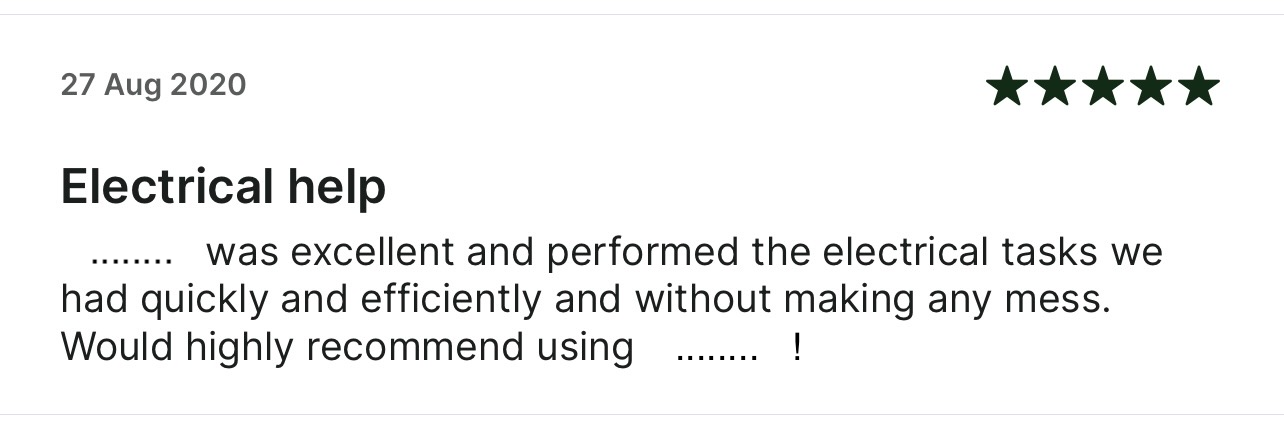
Electric Help ..... was excellent and performed the electrical tasks we had quickly and efficiently and without making any mess. Would highly recommend using ..... !
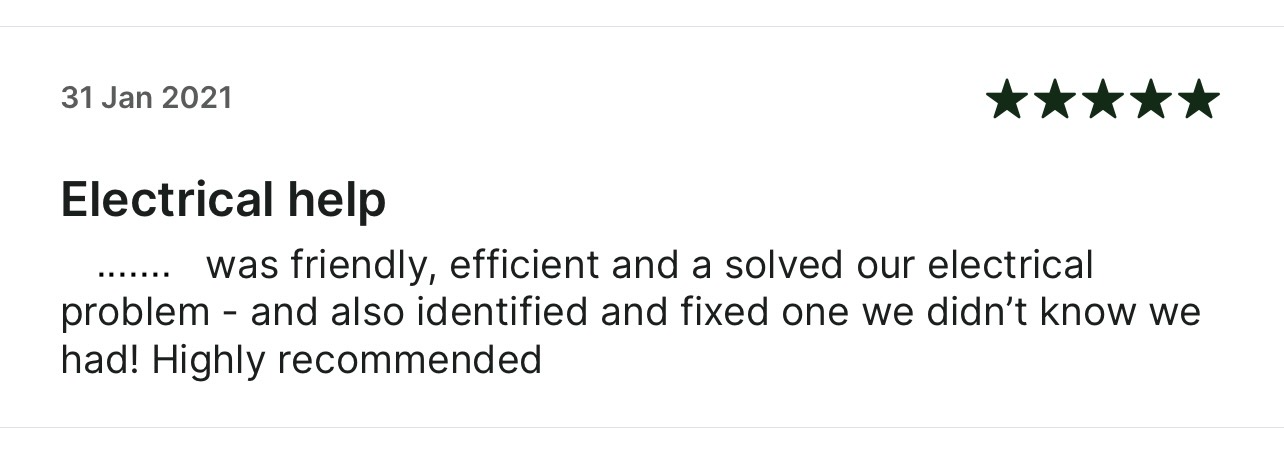
Electric Help ..... was friendly, efficient and a solved our electrical problem - and also identified and fixed one we didn't know we had! Highly recommended

Indoor Painting Best painter I have had the pleasure of hiring I would recommend him 100%
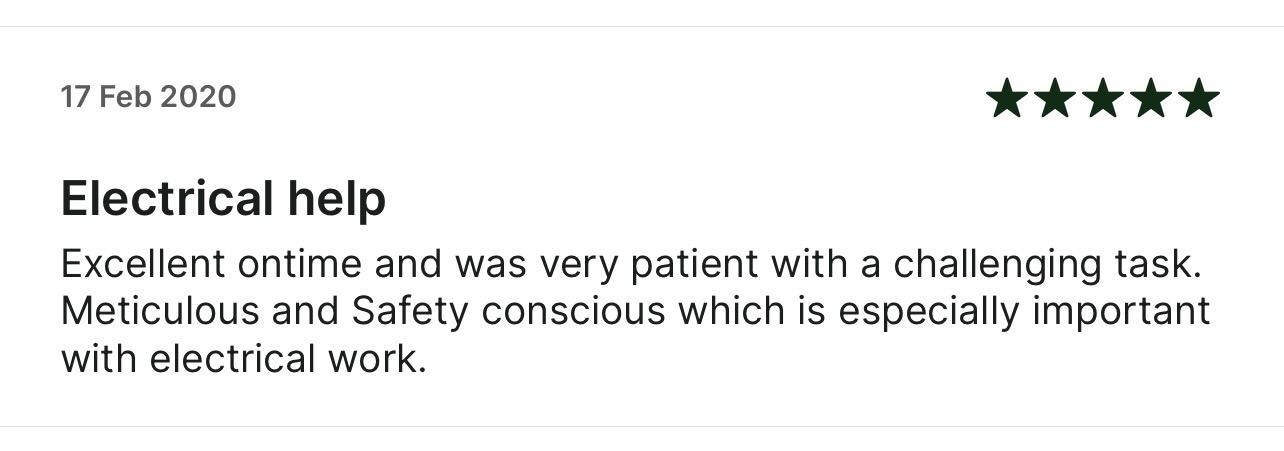
Electric Help Excellent ontime and was very patient with a challenging task. Meticulous and Safety conscious which is especially important with electrical work.

Electric Help Great work! Solid expertise, strongly recommended. Thank you ..... !

Indoor Painting Efficient and friendly; ..... does great quality work and leaves the place tidy which is more than a lot of tradespeople do! I would definitely recommend and hire again :)

Indoor Painting So grateful to have found ...... on TaskRabbit. His skill and attention to detail is excellent. He worked tirelessly to get the entire flat painted before I moved in, putting in some long hours. All along, he was very pleasant and professional to detail with. Would recommend his work to anyone!

Indoor Painting This is the second time we've had ..... to the house. He does a great job and has managed to fix a total disaster.

Electric Help Excellent! Explained everything well and solved plenty of problems

Electric Help Really great, quick service! Super professional. ..... fixed a problem with my dimmer lights that I've had for a few weeks. Another electrician hadn't solved the problem and ..... was able to really quickly and efficiently. Will use again!
Read more about: Founder Reviews | In Depth.
Read more about: Seipsum — Practical & Theoretical Validation.
Read more about: Founder — External Experience.
Seipsum-User Resonance Form
To request a session, please complete the information below:
Save Time | Gain Value | Structure Cognition
If you've read this entire webpage, ariving here: You Should Request a Session | If you're still undecided: Don't panic! Just check again the FAQ, and other relevant sections below.
Contact / Access
For access to Structured Cognitive Services, please write to:
Seipsum was built in collaboration with The Tinkerer-Thinker